Tuesday, December 28, 2010

Can We Hear Class in Music?

This is a question that I repeatedly ask myself as I think about the relationship between the music we hear and the society in which it’s performed. I started thinking about it again after reading a bit further into the work of János Maróthy, a Hungarian musicologist who specialized in discussing the inherence of social class in music and its history.

I pretty much rejected Maróthy out of hand while writing Dreaming in Middletown, mainly because I wanted to take a more open, cultural approach to music and class than his strict Marxist approach would permit. Also, his historical domain – feudal and proto-capitalist Europe – was quite distinct from the twentieth-century America which I was studying.

But Maróthy is concerned with a problem which faces any musicologist studying how the social is mediated through the musical. The issue isn’t about mapping consumption patterns or taste, or some crude one-to-one congruence of musical type to social group. It’s about how social realities are – what’s the right word here? – immanent, inherent, enacted in music itself.

Maróthy, studying bourgeois music in Europe, described what he saw as certain continuities of style which he felt were linked to the individualist, ego-centred nature of bourgeois consciousness. He saw something in the music, in its predictable phrase periods and its insistence on squareness and closure in its rhythmic and melodic character, that remained surprisingly regular across a fair swath of European history.

Though this is clearly a generalization that won’t hold up in every individual instance, the bourgeois style (mostly clearly seen in song, but also in instrumental concert music and other forms) musically expressed a worldview that stressed order, the security of boundaries, and regularity which Maróthy felt contrasted with the music of the peasant and working class.

Disappointingly, though, the clichés about the bourgeois world creep in: their music expresses the “emptiness” of bourgeois life, the emotionality of the music is described as artificial, full of fake sentimentality and overstated bombast. In his Marxist narrative, it is necessarily so.

But that doesn’t mean that Maróthy is not usefully wrestling with a central concern here, and his work provides a deep and meaningful meditation on the question of how music represents social reality (or rather, how social reality is *embodied* in music).

Maróthy wants to approach musical sound as something more than a system of signs or representations. For him, music’s rhythms and gestures are those of human activity itself, ritualized. For example, he states, “what is actually ‘in’, in a musical process, is neither the ‘meaning’ or some structural analogue of our feelings, neural substrates or the universe but we ourselves. It creates a field of force, in which we behave accordingly, in a real or imaginary way.”

In other words, human activity, and therefore the identities people perform, is inherent in music itself.

Now, this is not an unparalleled idea. Musicologists like Christopher Small, new musicologists like Susan McClary, ethnomusicologists all over the map, as well as some in cultural studies, have said something like this in a variety of ways.

The acknowledged problem with this approach is that the theory connecting music’s sounds with social structures has never been satisfactory. The loose ends were never quite tied together. Richard Middleton, reviewing Maróthy’s Music and the Bourgeois: Music and the Proletarian (1974), noted:

Another problem – one common to all sociologies of music – is the connection of musical technique to social determinant. On what grounds is, say, the bourgeois lyrical song to be related to certain socio-historical phenomena? One can accept so much on an intuitive basis, but when the system is extended into more detailed areas, doubt creeps in.


Ultimately, Middleton points out, the argument becomes circular. The social is inherent in music, because music is a social phenomenon.

Another commentator, Michael Morse, pointed out that Maróthy had other problems, such as explaining how bourgeois music could express a bourgeois class consciousness when the composers and performers of the music were not of that class. It was music for the bourgeois audience, but not made by them. “The tricky part,” says Morse, “is that Maróthy must assign a state (or content) of consciousness to people who not only were unaware that they had it, but who characteristically and vehemently deny that such a thing is possible in the first place.”

Maróthy is one of the few musicologists to really explore the possibility of the immanence of social class in music, and I benefited from using his example to revisit this question about how we can explain the connection between the social and the musical.

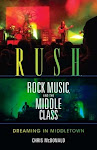
Sunday, October 24, 2010

On Springsteen and Working-Class Heroism

In rock, during the 1970s and 1980s, Bruce Springsteen projected the image of an American blue-collar hero.

As a performer, he is transcendently excellent and charismatic. I recall my own amazement at seeing what he does live, because it did not seem to translate in the studio. Hitherto, none of his songs seemed anything more than "alright" to me. You really have to see him live to get it. (If Canada has any equivalent to this, I think it's the Tragically Hip. Friends of mine raved about them, but I remember hearing their songs on the radio and finding them unremarkable, forgettable, middle-of-the-road rock. Once I saw them live, though, it all suddenly made sense.)

What's interesting for me about the whole Springsteen phenomenon, though, is the massive white-collar following he has amassed. Tongue-in-cheek, I've sometimes wondered if Springsteen is a liberal yuppie's fantasy-come-true of what a working-class man should be.

Well, it turns out some Springsteen fans have wondered about the same thing. In his ethnography of Bruce Springsteen fans (Tramps Like Us), Daniel Cavicchi quotes one fan who thinks that most Springsteen fans are not from Springsteen's own socio-economic background:

I've read numerous published comments on the nature of Bruce's audience being incongruous with the music he sings about. We tend to be mostly upper middle class and above....A friend once questioned how I had suffered in order to understand Bruce's music? The people Bruce wrote about early on were my family, the people in my town, but they weren't me....I do not believe that the people who truly understand and enjoy Bruce's talents live those lives. Quite frankly, if I was "laid off because of the economy," I don't want to sing about it....I think you could look across the audiences of our favourite singer-songwriters (Springsteen, Petty, Seger, Mellencamp) and see a remarkable economic and social homogeneity to the audience. I would like someone to explain to me why the 200 million plus Americans who live the life Bruce sings about haven't bought the albums.


This is a great question. I've never been sure if Springsteen's music colourfully and compelling represents blue-collar America to itself, or if it offers a tangible image for middle-class listeners of a noble, politically-correct (and non-threatening?) working-class icon. Woody Guthrie played a similar role for New York folk afficionados between the 1940s and 1960s, a musician whose subaltern origins seemed to inform a righteous progressivism that agreed with the sensibilities of liberal intellectuals. In some way, consuming ostensibly working-class music like Guthrie's or Springsteen's just feels right: it's a sign of good, liberal citizenship, like giving to charity, recycling, etc.

According to the fan quoted above, it's easy for the middle-class audience to empathize with the working class, as Springsteen sings about it. Other kinds of performers representing American working class life are probably harder for such an audience to empathize with. It's interesting to compare Springsteen (a rocker) with comparable male country stars (Merle Haggard, Charlie Daniels, Toby Keith). Unlike Guthrie or Springsteen, the political and social statements of these country singers are all over the map: their defiant pride in their blue-collar identity and anger at economic injustice might be consonant with progressive attitudes, but their forays into angry nationalism and conservative social causes repulse a liberal sensibility.

In the liberal middle-class imagination, then, Springsteen works as an affirmative, mythic icon of the American working class. He activates no redneck or hillbilly stereotypes for this audience, so the audience's prejudices don't stop them from embracing what he says.

Friday, September 24, 2010

Class, Race, and Visibility

There is a great article by Henry Giroux on the topic of class and race. Giroux reflects on how these impacted him as he grew up in Providence, Rhode Island in the 1960s.

It got me thinking further about the old cliche of the middle class being "the class that won't speak its own name," a seemingly empty, normal identity. Giroux remembers how class affected every aspect of his upbringing (he was raised in a blue-collar family), yet no one ever talked about it. Instead, it was race that was openly discussed, affirmed, fought over, etc.

Giroux describes "working-class" and "white" not merely as adjectives, but as verbs -- the very means by which those in his neighbourhood related to the social world around them. This was often through conflict. He notes,

Most of the interactions we had with others were violent, fraught with anger and hatred. We viewed kids who were black or privileged from within the spaces and enclaves of a neighborhood ethos that was nourished by a legacy of racism, a dominant culture that condoned class and racial hatred, and a popular culture that rarely allowed blacks and whites to view each other as equals, except of course, in athletics. Everywhere we looked segregation was the order of the day. Community was defined within racial and class differences and functioned largely as spaces of exclusion - spaces that more often than not pitted racial and ethnic groups against one another.


In spite of living through the divisions of race and class, Giroux notes how there seemed to be no language to talk about it. The divisions were so naturalized that they were assumed to be differences arising out of human nature, rather than constructed social divisions.

Music played an interesting role in all of this: for the working-class white kids (of which Giroux was one), African-American popular music was acceptable for listening, even if fraternizing with actual black kids was taboo. Meanwhile, the feeling of difference from middle-class kids resulted from being segregated from them at school (they never took the same classes), their ways of speaking, and, of course, their taste in popular music. The richer kids liked the clean-cut, mushier music of Pat Boone and stars of his ilk, which became an icon of effette elitism to the working-class kids.

On popular culture, Giroux elaborates,

Popular culture provided the medium through which we learned how to negotiate our everyday lives, especially when it brought together elements of resistance found in Hollywood youth films such as "Blackboard Jungle" (1955) or the rock n' roll music of Bill Haley and the Comets, Elvis Presley, Little Richard, Etta James, and other artists. Moreover, working-class street culture provided its own set of unique events and tensions in which our bodies, identities and desires were both mobilized and constrained.


Giroux remembers how being working-class in the US at this time meant being valued (if at all) for your physicality -- your ability at athletics, or your ability to labor manually -- and remembers how more affluent kids seemed to live outside their physicality.

Giroux notes that much of his own work in cultural studies has been a kind of "memory work," learning to understand explicitly the things about his early social environment which were never talked about openly and only understood implicitly. The activism of the 1960s, he says, did much to open his mind critically to class and racial divisions. But, as he notes, the pressure to keep perceptions of social difference under the surface of daily discussion remains pervasive.

Thursday, September 9, 2010

Cultural Influence: Bottom-Up vs. Top-Down

I want to make some notes on cultural influence across class lines. Charles Seeger is one of the few musicologists to make an issue of this. He wanted to document the emergence and eventual merging of class-based cultures in the US. Seeger was particularly interested in the notion of subacculturation, the process by which musical influences from one class became adopted by another.

Seeger used the familiar (if now outdated) three-part paradigm of the folk arts, the popular arts, and the fine arts. The folk arts were the home-made and passed-down musics of the rural settlers; the popular arts were the semi-literate and mass-distributed musics of the urban working class and middle class, while the fine arts were European classical music.

I realize that my statement in the previous post about class being more fluid in North America may miss the point. Mass communications in the 20th century probably made the cultures of different classes and regions more fluid, mobile, and open to appropriation by others. But it’s not the same thing as class itself being fluid.

This is significant because, as Seeger points out, the cross-fertilization between the folk and popular arts is a huge part of the story of popular music in the first half of the 20th century. The influence of rural forms of music (early folk balladry and fiddling, field hollers, gospel, country blues) on the music of the city was tremendous.

But the city and the world of vaudeville, film music and Tin Pan Alley (middle-class and middlebrow musics) left their stamps on these rural musics as they migrated into the urban centres. Thus we see the development of jazz, rhythm and blues, rock and roll, country music of various types, soul music, and so on.

The flow of cultural influence, in these cases, was mostly bottom-up. The music business took the music of the poorest in America and commodified it, allowing it to appeal across class lines, and sometimes across racial lines.

But, as Seeger notes, the attempt to send cultural influence from the top-down was not overly successful in the US. He references the nineteenth-century efforts, which he calls the “Make America Musical” movement, to implant European high musical culture in the US.

Orchestras were founded, music critics had columns in major newspapers, philanthropy by rich men like Andrew Carnegie led to the building of elite concert halls and opera houses, conservatories and musical pedagogies based on the European model were established, and on it went. Many music departments in universities across the US still bear marks of this effort to use European high culture as a standard for musical training in America.

Its success was mixed. Classical music in America struggled against a colonial/provincial mindset. The classical orchestra flirted with jazz at times, and the use of orchestral composition in American film-making has a distinguished history. But the sense of classical music as a central tradition (as in Europe) was never very strongly established. At best, it filtered downward through middlebrow channels, but even this way of mediating high culture seems to be fading away.

I wonder to what degree the relative success of bottom-up subacculturation accounts for the “culture wars” that have riven the US at various points. Since the nineteenth century, the American elites have had difficulty asserting their culture in a top-down process of assimilation, and they have had to adapt by colonizing and disciplining popular culture in various ways.

Perhaps the PMRC, Allan Bloom’s The Closing of the American Mind, conservative rock canons, and (in a way) talk radio represent elite reactions to the challenge of bottom-up subacculturation in American popular culture.

Thursday, August 19, 2010

On Artistic Integrity and Selling Out

One of the great Zen riddles of the rock era concerns artistic integrity and commercial success.

More of one is usually assumed to result in less of the other. Pleasing yourself or staying true to your initial small pool of fans is supposed to be superior to pleasing the masses and pandering to the lowest common denominator.

This is a central tenet of what academics call the "rock ideology," and has its origins in the counterculture, and selling out originally meant working for "the man" rather than yourself and your youth-based community.

But the idea has a much deeper history than that: it stretches back to the Romanticism of the 19th century. The Romantic notion of artistic purity being measured by the artist's brave flouting of conventions and rebellion against society's expectations continues to reverberate today.

Robert Pattison argued some time ago that rock mirrors Romanticism in many ways. But rock can only do so in a contradictory way. It is a mass commercial medium in the first place (it was never anything but that), and thus setting up an opposition between the uncommercial (authentic) artist vs. the commercial (artificial) entertainer in rock was always problematic.

This isn't to dismiss the oppositional, bohemian subcultures that popped up in rock's history at various times, but to acknowledge that bohemian oppositionality has often been a source of rock's commercial appeal.

There are lots of bands that used the rhetoric of the Romantic artist as a way of authenticating themselves, partly because they and their fans fervently believe in it.

As a Rush fan, I know I did. I liked the idea that the band "stuck to their guns" (so they said) and stayed true to their artistic vision, and shrugged off the fact that they'd never had a bona fide hit single. Yet -- and here's the rub -- I also remember feeling proud of my chosen group for their commercial success: the string of gold and platinum albums, that grandness of their live shows (and the size of arena they could fill). It somehow spoke to their strength as artists, the payoff for being so creatively bold.

There's nothing original about this: Led Zeppelin and many of their fans, King Crimson, and tons of other rock, prog and metal bands embraced this seeming contradiction.

I've been playing with the idea that this Romanticism is somehow linked to class, or at least to some kind of social privilege. Certainly, Romanticism arose at the time when the middle class was emerging in Europe; its individualism and revolutionary (anti-establishment) tenor is certainly part of the bourgeois culture of the time.

French sociologist Pierre Bourdieu wrote extensively about class and taste, and laid out clearly how those on the higher end of socio-economic spectrum view art and culture as something outside and above the world of economic exchange. Because they're too rich to have to worry about the material necessities, culture can be viewed in a disinterested way and appreciated for its own sake. Mass culture, for them, is crass; real art and refined aesthetics are not concerned with wide appeal and mass sales. (I've reduced this idea greatly -- see Bourdieu's Aristocracy of Culture and Gene H. Bell-Villada's Art for Art's Sake for a fleshing out of this.)

Now, of course, most rock stars don't start off rich, but the attitude that musical integrity matters more than fame, money and popularity suggests that the prospect of material deprivation is not taken overly seriously.

Contrast this with the sheer flaunting of wealth that has become stylistically prevelant in rap music: the issue of selling out barely registers. If you've known material deprivation with little prospect for escaping it, then of course you flaunt success when it comes. Poverty is what was shameful, not jumping on your ship when it comes in. Endorsements, clothing lines, cross-marketing -- bring it on.

Art for art's sake, then, is an idea that originates in privileged circumstances. The starving artist is a Romantic, noble thing as long as it symbolizes idealism, not an inescapable reality. But does that mean that only the privileged buy into this idea?

I'm only playing around with this theme right now, because the idea of art for its own sake seems to have played a role in a lot of subcultural movements with a strong working-class base -- it's not just a middle-class thing. I'm wondering if its significance connects more forthrightly to an ethnically white/Western cultural position, because it shows up in white-dominated popular genres more than black, Latin or other immigrant genres in North America.

So maybe the art for art's sake attitude is something shared across class lines within an ethnic group. This leaves the door open for thinking about what Charles Seeger calls subacculturation -- literally, the transferring of cultural influence from one social class to another. With its history of having a relatively fluid or porous class structure, North America has been more open to subacculturation than Europe.

More on this in the next post.

Wednesday, July 28, 2010

What Does "The Trees" Say About Class?

Well, I'm having a little author's regret about not talking more in depth in Dreaming in Middletown about Rush's "The Trees," an enduringly popular song from Hemispheres (1978).

I addressed it briefly while talking about the political meanings of individualism as Rush used it. But this song, which is told a bit like a kid's fairy tale or fable, bears a lot more discussion from the standpoint of class.

Above all, it's the one Rush song that specifically and literally is about stratification.

Neil Peart transposes this issue to the forest: the Oaks, by virtue of naturally growing the tallest, get most of the sunlight; the Maples, shorter in stature, get less. The Maples demand an equal share of the sunlight, but the Oaks balk. The Maples form a union, protest loudly, and a law is passed that light shall be distributed evenly. The result is that the forest is cut down to stumps.

What view of social stratification does this song provide?

The lyrics seem fairly straightforward on this: stratification is considered an inevitable, perhaps natural, aspect of society. Some have more access to wealth and resources than others. Attempts to alter the existing arrangement (e.g., by unions) are unwelcome in this story: more equitable distribution results in catastrophe.

Anyone who cares already knows that Peart was influenced by Ayn Rand at this time, and the influence of her philosophy on this song is so obvious as to make comment unnecessary. I’m not really interested in literary influence here, anyway: I’m much more interested in thinking about how social positioning makes this story desirable or relevant.

Clearly, it’s a song that flatters conservative sensibilities: it cautions against changing the status quo. Existing inequities are deemed natural. The perspective seems at least middle class: the idea of lower classes banding together and making demands is portrayed as catastrophic, and perhaps this view is fuelled by middle-class status anxiety. I certainly don’t see how working-class interests are at all served by the song’s rhetoric, whatever my critics might say.

"The Trees" may be one of Rush's most perplexing songs.

Not musically, of course -- it's quite nice. The classical guitar intro is atmospheric and attractive. The rock sections are quintessential Rush -- odd meters, open chords, intense vocals -- as is the bridge, with its gentle arpeggios, unusual percussion items, and mysterious synthesizer. In less than five minutes, it pretty near captures the best in Rush's classic 1970s style.

The lyrics have been a weird sticking point. Rush's biographers have been pretty coy about what the song is really about. The British rock press, says Rush author Brian Harrigan, pilloried the band for making a sweeping conservative statement with the song, but Harrigan demurred, saying that "it can be read as a union-bashing song but I think that only diminishes what Peart is saying -- peaceful co-existence and live and let live are all" (1982). But in a review of Exit...Stage Left a short while later, Harrigan admitted that he found "The Trees" "jarring" politically.

I’ve seen this in a number of reviews of Rush, where the pro-Rush writer either avoids discussion of this song’s message or diverts from the (plain) message as Harrigan did. Reviewers who dislike Rush will raise this song as an example of band’s bafflingly strident defence of class privilege (see reviews of Rush in the NME, or Paul Stump’s summary in The Music’s All That Matters).

On the one hand, it’s interesting that the song evokes such reactions, since it reads like an almost simple-minded cartoon. But it tells a story about the important matter of social stratification, and it hits a nerve.

The middle class is conflicted on this topic, and this is where middle-class political sympathies get complicated. Some of us (maybe parts of us) identify with the Oaks: we deserve what we have, we see ourselves among the upright in society, we think what we do is important, etc. Some of us identify with the Maples: stratification is not fair, merit is too often confused with chance or birthright, we are slipping from “haves” into “have-nots” as the elite grows taller, and so on.

But that still doesn’t quite get at it. As I discussed in Dreaming in Middletown, the position from which Rush writes is mostly petit-bourgeois, lower middle class. This is the small business class, the freelance professionals, the shop-keepers -- the people who are politically and economically in-between -- who end up equally resenting unionism and corporate elites. They are told that they are the engine of the “real economy,” and they believe that, in a more laissez-faire world, they would be the Oaks. Stratification would work fine for them, if not for all the rule-changing, lobbying, and politicking that goes on and gerrymanders the system.

That’s my take on why something like “The Trees” portrays stratification as it does. We really need a good social history on movements like libertarianism and objectivism: so much discussion of them is either political (aimed at persuading or dissuading) or is abstractly philosophical. But so much of the story lies in who these movements appeal to, what needs or desires they address, and what historically accounts for their peaks and ebbs of popularity. Their role in debates over social stratification is ultimately a huge part of their raison d’etre.

Sunday, July 11, 2010

Disciplinary Divides, Social Divides? (II)

The New (Ethno)Musicologies, a collection edited by Henry Stobart, was published recently, and has a number of contributions that speak to the issue I wrote about a few months back.

The idea of a specific discipline catering to particular social categories, and hence certain musical topics, could be extended to further issues. The book features contributors from a number of different disciplines, many discussing how ethnomusicology and musical ethnography looks to them.

Fabian Holt, writing from popular music studies, notes that his discipline is focused on an Anglo-American pop canon where almost no ethnography is done. Ethnomusicology, when it focuses on popular music, looks almost entirely outside that canon, and does approach its topic ethnographically. He notes that many "American musics" not well-covered in popular music studies -- that of Asian-Americans, or Latin-Americans -- are far more likely to be picked up by ethnomusicologists.

Popular music studies, says Holt, sees its musical field as defined almost entirely by a dialectic between African- and Euro-American culture, gives Latin American music just a little attention, and Aboriginal and Asian-American musics almost no attention at all. The disciplinary lines in these inclusions and exclusions are clear for Holt: "To this day, there are deep differences in the core conventions of what is studied and how in popular music studies, musicology, and ethnomusicology" (p. 42).

I was happy to see an acknowledgement of how social class plays into this. Holt notes:

Academic culture has largely been centred on the white middle-class male subject, and middle-class values have defined the status of individual musics. Western, especially German, art music was the single privileged domain of early musicology, and it still dominates in...prestige. Conversely, stereotypes of "non-Western" musics and popular musics have worked to the disadvantage of scholars in ethnomusicology and popular music studies. Middle-class dominance in the latter is evident in almost complete ignorance of a working-class rural music such as country music.


I generally agree, though as my previous posts indicate, the sense of what is canonically acceptable middle-class or working-class music to a hip middle-class gaze bears much further interrogation.

Michelle Bigenho, an anthropologist who studied musical culture in Bolivia, writes about why she refuses the designation "ethnomusicologist." What I found interesting here is her refusal to assume that music is a unique or autonomous category in culture. In her experience, anthropology treats music as a part of larger cultural themes and practices, while in ethnomusicology, the centrality of music as a topic tends to edge out (or overdetermine) other considerations. She blames the departments and institutions that structure our disciplines: music departments expect ethnomusicologists to play music, teach ensembles, teach area studies and genres, so that's what gets studied. Anthropologists would never do this; music is not always so isolatable, and indeed, this would be seen by some as a counterproductive way to understand a culture.

I'm just starting on Nicholas Cook's essay on musicology vis a vis ethnomusicology, but it looks like more promising insights on this are to come.