John Guillory wrote an incisive review of literary critic Harold Bloom's The Western Canon a while back.
Bloom's book, apart from being a summary of the great works of Western literature (Dante, Milton, Shakespeare, etc.), contained a caustic introductory essay and a biting conclusion, accusing the contemporary professoriate of destroying standards in the humanities and bitterly dismissing aesthetic value in the arts.
How does Bloom think they did this? By daring to look at the social and political contexts in which the great works of Western literature were created, and asking how canons themselves are formed.
Bloom's complaint partly rested on the notion that great literature's "greatness" was wholly dependent on aesthetic value, something that only dedicated and gifted ("deep") readers could access or experience. Any other question about it was either beside the point or actively subversive to the appreciation of great works.
Guillory brilliantly cut through Bloom's rhetoric, assertively showing who Bloom was aiming this book at, and why.
Bloom was not aiming at "deep readers" of Western literature, Guillory surmises. He was aiming at middlebrow readers who would never, ever actually read through any substantial portion of the canon. He told such an audience exactly what they wanted to hear: great literature is great, period. He gave them capsule summaries of great works so that they could feel, at some level, conversant with its topics, plots, and characters.
And he played right to their prejudices: great literature frustrates all attempts at analysis or interpretation. There are no politics here. Aesthetic greatness transcends history. In short, shut up and appreciate! And if you can't appreciate, just shut up!
Bloom -- despite being a professor himself -- plays to the anti-intellectual tendencies of a public that deeply mistrusts intellectual work. He accuses his colleagues of asking the wrong questions, teaching the wrong works of culture, undertaking studies that undermine, rather than buttress, the "old" way Western culture was taught.
Guillory argues that Bloom ended up creating an elitism that doubles as populism. Bloom seems to argue that the greatness of high culture needs to be protected from elite intellectuals, the very guardians and teachers of that culture. Anxiety about high culture -- what it is, who it is for, what it means -- is assuaged by assuring the middlebrow reader that it doesn't belong to anyone in particular.
Intellectual work on popular culture, interestingly enough, is sometimes met by the layperson with the kind of response Bloom encouraged: the charge is often that intellectuals over-analyze and miss the point of what they study.
One review of a recent popular music study (not mine) even states this outright, admonishing the author to just "shut up and play your guitar." But really, the reviewer was incensed that certain questions were asked, that critical reflection was undertaken, rather than discussing the music on its own (fan's?) terms.
Monday, April 5, 2010

Friday, March 19, 2010
Disciplinary Divides and Social Divides? (I)
Popular music studies is an interdisciplinary exercise.
Sociology, cultural studies, English, communications, musicology, music theory, ethnomusicology, anthropology -- these are some of the disciplines that have contributed to popular music studies.
But being interdisciplinary, as Stanley Fish once said, is so very hard to do.
At least part of the problem is that different disciplines come at any topic with their own strengths and weaknesses, and they tend to grab at topics which they can most easily explain. There are notable exceptions to this, but there seems to be a divide among the disciplines that do popular music studies, leading to very interesting musical divides. These, in turn, reflect social divides.
Take, for example, music theory's (and to a lesser degree, musicology's) contributions: the tendency has been to study popular song that has relatively complex forms and interesting chord progressions. Thus, progressive rock, psychedelic rock, the Beatles, and some of the more clever singer-songwriters have received significant attention. Heavy metal, too, has gotten its share of attention, with its modalities and virtuosic guitar solos providing fodder for analysis. Even recent work on girl groups draws off of a repertoire with some advanced compositional and arrangement techniques -- the world of the Brill Building and Motown was self-consciously professionalized, after all.
On the other side, consider cultural studies and sociology: their emphasis on working-class lifestyles and subcultures have led to revealing work on punk rock, the mods, the London rasta and rudie scene, and so on. Likewise, the interest in reading (postmodern) texts led to a flurry of studies on music video.
I'm obviously being reductive here to make a point, but I find it interesting how these two disciplinary areas have had little to say about musical topics across their divides. For example, in Frith and Horne's sociological book, Art into Pop, the authors stress in the introduction that this is about the role an education in fine arts had on musician-artists who ended up in popular music; they issue a stern caveat that they are not interested in so-called "art rock," that classically-influenced stuff that bands like ELP peddled. What follows is stuff like the Velvet Underground, Roxy Music, Talking Heads, PiL -- pop on the proto-punk/punk rock/new-wave axis.
On the other side of the divide, punk has gotten little musicological attention. In his seminal Rock: The Primary Text, musicologist Allan Moore dutifully (if briefly) surveys punk as a substyle of rock, only to dismiss it as something that will be seen as having had a limited stylistic influence on rock at large. (A speculation which I'm guessing was probably written around 1990, before alternative rock really took off -- the original book came out in 1993.)
I have to confess my own complicity in this divide: by writing about Rush, I was doing the musicological thing of diving into something that was self-consciously designed to be interesting to a certain kind of musician. Rush analyzes "well" musicologically. It's a convenient topic, from one standpoint.
What bears further thought is how the relationship between social divides and musical divides (which we are mostly aware of) also interrelates with disciplinary divides. Most of us working in popular music studies are striving to do interdisciplinary work, but each discipline carries its baggage.
Sociology, cultural studies, English, communications, musicology, music theory, ethnomusicology, anthropology -- these are some of the disciplines that have contributed to popular music studies.
But being interdisciplinary, as Stanley Fish once said, is so very hard to do.
At least part of the problem is that different disciplines come at any topic with their own strengths and weaknesses, and they tend to grab at topics which they can most easily explain. There are notable exceptions to this, but there seems to be a divide among the disciplines that do popular music studies, leading to very interesting musical divides. These, in turn, reflect social divides.
Take, for example, music theory's (and to a lesser degree, musicology's) contributions: the tendency has been to study popular song that has relatively complex forms and interesting chord progressions. Thus, progressive rock, psychedelic rock, the Beatles, and some of the more clever singer-songwriters have received significant attention. Heavy metal, too, has gotten its share of attention, with its modalities and virtuosic guitar solos providing fodder for analysis. Even recent work on girl groups draws off of a repertoire with some advanced compositional and arrangement techniques -- the world of the Brill Building and Motown was self-consciously professionalized, after all.
On the other side, consider cultural studies and sociology: their emphasis on working-class lifestyles and subcultures have led to revealing work on punk rock, the mods, the London rasta and rudie scene, and so on. Likewise, the interest in reading (postmodern) texts led to a flurry of studies on music video.
I'm obviously being reductive here to make a point, but I find it interesting how these two disciplinary areas have had little to say about musical topics across their divides. For example, in Frith and Horne's sociological book, Art into Pop, the authors stress in the introduction that this is about the role an education in fine arts had on musician-artists who ended up in popular music; they issue a stern caveat that they are not interested in so-called "art rock," that classically-influenced stuff that bands like ELP peddled. What follows is stuff like the Velvet Underground, Roxy Music, Talking Heads, PiL -- pop on the proto-punk/punk rock/new-wave axis.
On the other side of the divide, punk has gotten little musicological attention. In his seminal Rock: The Primary Text, musicologist Allan Moore dutifully (if briefly) surveys punk as a substyle of rock, only to dismiss it as something that will be seen as having had a limited stylistic influence on rock at large. (A speculation which I'm guessing was probably written around 1990, before alternative rock really took off -- the original book came out in 1993.)
I have to confess my own complicity in this divide: by writing about Rush, I was doing the musicological thing of diving into something that was self-consciously designed to be interesting to a certain kind of musician. Rush analyzes "well" musicologically. It's a convenient topic, from one standpoint.
What bears further thought is how the relationship between social divides and musical divides (which we are mostly aware of) also interrelates with disciplinary divides. Most of us working in popular music studies are striving to do interdisciplinary work, but each discipline carries its baggage.
Wednesday, March 10, 2010
Humour and Detachment (Rush)
Chapter 4 of Rush, Rock Music, and the Middle Class focuses on issues of seriousness and detachment in Rush. I looked at how this was apparent in their lyrics, musicianship, and live performance. What emerged was a band carefully positioning itself as a highly disciplined group of musicians, making thoughtful and serious observations about life and society.
This image may be a bit dated now. Late-career Rush seems quite a bit less invested in an image of thoughtful seriousness, and the band seems much more at ease with its public profile. Film and TV cameos have been growing in frequency in recent years (Colbert, Rick Mercer, I Love You Man, Suck, and Trailer Park Boys, to name some of the bigger profile cameos). Peart's recent re-versioning of the old Hockey Night in Canada theme seemed like good fun, as well as a nod towards his native country. Is Rush, contra "Limelight," actually starting to have fun (in the public eye) with celebrity?
To be fair, though, humour has been an aspect of Rush for some time. In some ways, the recognition of that humour, often buried in liner notes, album covers and the odd interview, was something the band shared with its most attentive and devoted fans.
The pun-on-top-of-pun on the Permanent Waves cover is one example. The model on the cover has a permanent wave; the title was a rejoinder to music critics' fawning over "new wave" rock, the storm-surge behind the model at once added more "waves" while also referring obliquely to the introduction of "Natural Science," and the "Dewey(i) Defeats Truman" headline on the Chicago Tribune newpaper, blowing in the wind, symbolized what Rush fans (offended by dismissive music critics) already believed: the press doesn't always get it right! Lots of nudges and winks.
The band let some of its in-jokes become public knowledge, which the fans came to cherish: the nicknames, the droll banter in concert programs, the silly inspirational slogans on the walls of the studio. By the 2000s, when Geddy Lee replaced his bass speaker cabinets with laundry machines and chicken rotisseries, the jokes weren't even so "inside" anymore.
In 1994, Neil Peart commented straightforwardly on the tension between Rush's seriousness and Rush's frivolity. He told Seconds's Stephen Blush, "Our work is serious in nature. But just because we take our work seriously doesn't mean we take ourselves seriously. That's the distinction we make, and that would certainly represent an important distinction. Our concerts are very important to us....Making records is the same way, we apply everything we have to doing it, but it doesn't mean we don't laugh afterwards."
For a band that produces very serious songs like "Losing It," "The Pass" and "Natural Science," the balance provided by a healthy sense of humour makes some sense.
But humour, itself, can also be a gesture of detachment. Irony is a great example of this. The humour of saying exactly what you obviously don't mean is the basis of irony, but this device of speech is also used to say the things we mean, but which we feel uncomfortable saying seriously and outright. ("Yeah, like I'd really love to listen to nerdy band like Rush!...[actually, I would...]) Sometimes, it's more comfortable to say something you mean in jest, because it gives you an out: you are detached from what you are saying.
Peart's quote reminds me a little of this. The music is serious, but the band detaches itself from that seriousness. It's another way of showing distance, which I discussed in chapter 1.
This image may be a bit dated now. Late-career Rush seems quite a bit less invested in an image of thoughtful seriousness, and the band seems much more at ease with its public profile. Film and TV cameos have been growing in frequency in recent years (Colbert, Rick Mercer, I Love You Man, Suck, and Trailer Park Boys, to name some of the bigger profile cameos). Peart's recent re-versioning of the old Hockey Night in Canada theme seemed like good fun, as well as a nod towards his native country. Is Rush, contra "Limelight," actually starting to have fun (in the public eye) with celebrity?
To be fair, though, humour has been an aspect of Rush for some time. In some ways, the recognition of that humour, often buried in liner notes, album covers and the odd interview, was something the band shared with its most attentive and devoted fans.
The pun-on-top-of-pun on the Permanent Waves cover is one example. The model on the cover has a permanent wave; the title was a rejoinder to music critics' fawning over "new wave" rock, the storm-surge behind the model at once added more "waves" while also referring obliquely to the introduction of "Natural Science," and the "Dewey(i) Defeats Truman" headline on the Chicago Tribune newpaper, blowing in the wind, symbolized what Rush fans (offended by dismissive music critics) already believed: the press doesn't always get it right! Lots of nudges and winks.
The band let some of its in-jokes become public knowledge, which the fans came to cherish: the nicknames, the droll banter in concert programs, the silly inspirational slogans on the walls of the studio. By the 2000s, when Geddy Lee replaced his bass speaker cabinets with laundry machines and chicken rotisseries, the jokes weren't even so "inside" anymore.
In 1994, Neil Peart commented straightforwardly on the tension between Rush's seriousness and Rush's frivolity. He told Seconds's Stephen Blush, "Our work is serious in nature. But just because we take our work seriously doesn't mean we take ourselves seriously. That's the distinction we make, and that would certainly represent an important distinction. Our concerts are very important to us....Making records is the same way, we apply everything we have to doing it, but it doesn't mean we don't laugh afterwards."
For a band that produces very serious songs like "Losing It," "The Pass" and "Natural Science," the balance provided by a healthy sense of humour makes some sense.
But humour, itself, can also be a gesture of detachment. Irony is a great example of this. The humour of saying exactly what you obviously don't mean is the basis of irony, but this device of speech is also used to say the things we mean, but which we feel uncomfortable saying seriously and outright. ("Yeah, like I'd really love to listen to nerdy band like Rush!...[actually, I would...]) Sometimes, it's more comfortable to say something you mean in jest, because it gives you an out: you are detached from what you are saying.
Peart's quote reminds me a little of this. The music is serious, but the band detaches itself from that seriousness. It's another way of showing distance, which I discussed in chapter 1.
Thursday, March 4, 2010
Southern Music & The US Working Class (I)
I was going through Bill Malone's excellent history of country music, Don't Get Above Your Raisin', while prepping for my popular music class this week.
The class's topic was the backlash against the 1960s counterculture levelled by country artists like Merle Haggard, which so clearly show the social distance they felt from 60s political activism.
Haggard's "Okie from Muskogee" expressed, with wit and sarcasm, the feelings of conservative, blue-collar, small-town folk about the excess and hedonism of the hippie counterculture. The song also criticizes the hippies (or, more accurately, the anti-war protest) for dissenting against the government and thus against the nation. It was the first in a long series of country songs with a nationalistic, love-it-or-leave-it attitude towards the US.
The "other" in "Okie from Muskogee" is never really named apart from the hippies, but implicity, the opposite of the small-town, blue-collar, white man is the urban, middle-class, university-educated white man. In other words, it's about class, not race. (Gender-wise, I get the sense that the ideal or "addressed" listener is male -- not sure why).
Malone's book is principally concerned with the white American working class and what country music meant to this constituency. I was interested in what Malone had to say about the politics that get expressed in country.
Malone shows that country music's populist basis once overlapped with some progressive politics -- see the Depression song "Hurrah for Roosevelt," praising the New Deal and the president's concern with the plight of working people -- and he deals with the apparent conservative turn that the American working class seemed to make after the social changes of the 1960s divided the nation. "Okie" was one of the harbingers.
However, the politics of the American working class, especially as expressed in country music over the past 40 years, is a riddle to most social scientists. The clinging to rugged American individualism, the hardcore religiosity, the disdain for "liberal elites," the "my country right-or-wrong" nationalism is perplexing when it seems so clear, given the massive income disparities in the US, that the working class should logically embrace a more progressive politics. Explanations for this are usually very condescending. The assumption is that they are duped, uneducated, justifiably angry yet misdirected, or some combination of these.
Malone's argument is simply that country music's politics can't be pinned down in any simple way. Fair enough: the social class backgrounds described implicitly in country music aren't singular or monolithic. But Malone's conclusion also indicates that a lot more research and analysis is left to be done.
The class's topic was the backlash against the 1960s counterculture levelled by country artists like Merle Haggard, which so clearly show the social distance they felt from 60s political activism.
Haggard's "Okie from Muskogee" expressed, with wit and sarcasm, the feelings of conservative, blue-collar, small-town folk about the excess and hedonism of the hippie counterculture. The song also criticizes the hippies (or, more accurately, the anti-war protest) for dissenting against the government and thus against the nation. It was the first in a long series of country songs with a nationalistic, love-it-or-leave-it attitude towards the US.
The "other" in "Okie from Muskogee" is never really named apart from the hippies, but implicity, the opposite of the small-town, blue-collar, white man is the urban, middle-class, university-educated white man. In other words, it's about class, not race. (Gender-wise, I get the sense that the ideal or "addressed" listener is male -- not sure why).
Malone's book is principally concerned with the white American working class and what country music meant to this constituency. I was interested in what Malone had to say about the politics that get expressed in country.
Malone shows that country music's populist basis once overlapped with some progressive politics -- see the Depression song "Hurrah for Roosevelt," praising the New Deal and the president's concern with the plight of working people -- and he deals with the apparent conservative turn that the American working class seemed to make after the social changes of the 1960s divided the nation. "Okie" was one of the harbingers.
However, the politics of the American working class, especially as expressed in country music over the past 40 years, is a riddle to most social scientists. The clinging to rugged American individualism, the hardcore religiosity, the disdain for "liberal elites," the "my country right-or-wrong" nationalism is perplexing when it seems so clear, given the massive income disparities in the US, that the working class should logically embrace a more progressive politics. Explanations for this are usually very condescending. The assumption is that they are duped, uneducated, justifiably angry yet misdirected, or some combination of these.
Malone's argument is simply that country music's politics can't be pinned down in any simple way. Fair enough: the social class backgrounds described implicitly in country music aren't singular or monolithic. But Malone's conclusion also indicates that a lot more research and analysis is left to be done.
Saturday, February 27, 2010
Music/Class/Suburbia: Revisiting Burlington in the 1980s
Growing up in the 1980s in south Burlington, Ontario, there was quite a wide range of social class living in a fairly close radius. Upper and upper-middle-class families lived frequently along the shores of Lake Ontario (with even larger and more expensive homes going up in that area now than when I was young). Just back from the lake, there were a lot solidly middle-class areas, particularly around the downtown, with lots of professionals and white collars who commuted either to Toronto or Hamilton. There were also a lot of war-era bungalows around, where lower-middle-class and respectable working-class families lived. There were some lower-income apartments dotting the area, especially near the Mall, but the land-use was clearly biased towards single family homes. Burlington had fast become a suburb, after all.
The high school I attended reflected this mix. It's probably a function of my own petit-bourgeois background that I wasn't always sure where I fit in. The upper-middle-class kids seemed a world apart to me; I had some working-class friends, but I remember some of them being taken aback when it turned out that I lived virtually inside the affluent Roseland neighbourhood.
Rush fandom, aside from being almost exlusively male as far as I could see, was similarly class-confusing at my high school. Most of the upper-middle-class kids had no use for Rush; they were as declasse as Iron Maiden, Styx and Judas Priest, and any other such metal or FM-oriented arena-rockers. Some headbangers loved Rush, but so did some of the kids in the chess club, and they frequently weren't part of the same constituency. If there was a centre to Rush fandom from which it radiated, it seemed to be in the lower middle class.
It's hard to remember much now about how musical taste and class identity aligned (or didn't align), but among the male constituency, different types of rock seemed to have their place among certain groups or cliques. The preppier guys seemed to like artier, more ironic kinds of music, like new wave and some technopop. Some of them were into jazz. The preferred types of rock seemed to get "harder" as you moved into the more lower-middle-class and working-class groups. However, genres like hardcore punk were hard to place, especially since (in North America) this type of music was heavily associated with college radio and the university circuit -- it wasn't "dole queue rock" as it was sometimes called in the UK.
The late 1980s was also the time when eclecticism was picking up as a new sort of highbrow stance, and I remember the "I like everything but country" cliche starting to circulate around this time. This was a stance I took with my musical taste late in high school; it was now part of middle-class identity to treat the whole cultural field as a big smorgasbord.
But the fact that country and sometimes rap were excluded from this declaration of broad taste definitely showed how divisions of class and other kinds of social distance were still clearly operating.
The high school I attended reflected this mix. It's probably a function of my own petit-bourgeois background that I wasn't always sure where I fit in. The upper-middle-class kids seemed a world apart to me; I had some working-class friends, but I remember some of them being taken aback when it turned out that I lived virtually inside the affluent Roseland neighbourhood.
Rush fandom, aside from being almost exlusively male as far as I could see, was similarly class-confusing at my high school. Most of the upper-middle-class kids had no use for Rush; they were as declasse as Iron Maiden, Styx and Judas Priest, and any other such metal or FM-oriented arena-rockers. Some headbangers loved Rush, but so did some of the kids in the chess club, and they frequently weren't part of the same constituency. If there was a centre to Rush fandom from which it radiated, it seemed to be in the lower middle class.
It's hard to remember much now about how musical taste and class identity aligned (or didn't align), but among the male constituency, different types of rock seemed to have their place among certain groups or cliques. The preppier guys seemed to like artier, more ironic kinds of music, like new wave and some technopop. Some of them were into jazz. The preferred types of rock seemed to get "harder" as you moved into the more lower-middle-class and working-class groups. However, genres like hardcore punk were hard to place, especially since (in North America) this type of music was heavily associated with college radio and the university circuit -- it wasn't "dole queue rock" as it was sometimes called in the UK.
The late 1980s was also the time when eclecticism was picking up as a new sort of highbrow stance, and I remember the "I like everything but country" cliche starting to circulate around this time. This was a stance I took with my musical taste late in high school; it was now part of middle-class identity to treat the whole cultural field as a big smorgasbord.
But the fact that country and sometimes rap were excluded from this declaration of broad taste definitely showed how divisions of class and other kinds of social distance were still clearly operating.
Thursday, February 25, 2010
Reconsidering the Middle Class
Now that Dreaming in Middletown is published, I want to briefly touch on the road I could have taken, and didn't.
I am fully aware that my conception of the North American middle class, which operated throughout the book, is open to the challenge that what I described as "middle class" may be understood from a different perspective as just a "higher" echelon of the working class.
I remember discussing this with a colleague of mine at York U -- a lifelong Marxist -- who disagreed that the suburbs were middle-class. These were some questions he put to me after I described my ideas for sketching North America's middle class. Do you have to be at least middle-class to own your own house? Does earning a salary rather than an hourly wage automatically admit you to a different class? Is white-collar labour really so different (in principle) from manufacturing and service-sector jobs? When I said "middle class North Americans," was I really talking (mostly) about embourgeoised workers?
These are good questions. Excluding the small entrepreneurs and self-directed professionals who are best described as petit-bourgeois, many of the white collar guys who grew up in suburban environs and might recognize themselves in the teenage protagonist in the "Subdivisions" narrative may think of themselves as middle-class while working under conditions that befit an upper-working-class definition in much classic Marxist sociology. At best, they might be described as society's "middle layers," but not middle class, per se.
Nevertheless, I chose to thow my lot in with an eminent American sociologist (C. Wright Mills), certain American historians (Burton Bledstein, Peter Stearns) and American cultural critics (Rita Felski, Lorraine Kenney) and call these white collars, professionals and entrepreneurs part of the "new middle classes," as we've known them since the late 1940s.
It seemed to me that there was a cultural ethos among the middling sorts that had a distinct, bourgeois flavour, even if it didn't fit Marxist models.
It doesn't hurt that the middle class is such a North American catch-all. A band like Rush can attract fans from across the social spectrum with their middle-class-inflected music because so many of us -- white collars, blue collars, new collars, no-collars -- think of ourselves as middle class, living the American dream.
But it remains open to the challenge that middle-class identification is really some kind of false consciousness. We think we're middle class just because we aren't poor. Or because we've grown up thinking of our position in society as unique, or a product of merit or maybe accident.
It's hard for North Americans to "think straight about class," as Rita Felski writes, because we talk so little about it, we have almost no sensible language for it. Race and gender are so much easier, and so visible; but class is almost a taboo. It's also bloody complicated: an auto worker may earn more than a high school teacher, but teachers have to have a university degree, and some teachers have more than one. Meanwhile, artists, classical musicians, and others who produce "high culture" sometimes live close to the poverty line. Class and social position aren't just about wealth.
There's so much to consider, and so many ways in which class is lived and performed. And there's so much to think about where it intersects with music: a whole history is there, waiting to be written.
I am fully aware that my conception of the North American middle class, which operated throughout the book, is open to the challenge that what I described as "middle class" may be understood from a different perspective as just a "higher" echelon of the working class.
I remember discussing this with a colleague of mine at York U -- a lifelong Marxist -- who disagreed that the suburbs were middle-class. These were some questions he put to me after I described my ideas for sketching North America's middle class. Do you have to be at least middle-class to own your own house? Does earning a salary rather than an hourly wage automatically admit you to a different class? Is white-collar labour really so different (in principle) from manufacturing and service-sector jobs? When I said "middle class North Americans," was I really talking (mostly) about embourgeoised workers?
These are good questions. Excluding the small entrepreneurs and self-directed professionals who are best described as petit-bourgeois, many of the white collar guys who grew up in suburban environs and might recognize themselves in the teenage protagonist in the "Subdivisions" narrative may think of themselves as middle-class while working under conditions that befit an upper-working-class definition in much classic Marxist sociology. At best, they might be described as society's "middle layers," but not middle class, per se.
Nevertheless, I chose to thow my lot in with an eminent American sociologist (C. Wright Mills), certain American historians (Burton Bledstein, Peter Stearns) and American cultural critics (Rita Felski, Lorraine Kenney) and call these white collars, professionals and entrepreneurs part of the "new middle classes," as we've known them since the late 1940s.
It seemed to me that there was a cultural ethos among the middling sorts that had a distinct, bourgeois flavour, even if it didn't fit Marxist models.
It doesn't hurt that the middle class is such a North American catch-all. A band like Rush can attract fans from across the social spectrum with their middle-class-inflected music because so many of us -- white collars, blue collars, new collars, no-collars -- think of ourselves as middle class, living the American dream.
But it remains open to the challenge that middle-class identification is really some kind of false consciousness. We think we're middle class just because we aren't poor. Or because we've grown up thinking of our position in society as unique, or a product of merit or maybe accident.
It's hard for North Americans to "think straight about class," as Rita Felski writes, because we talk so little about it, we have almost no sensible language for it. Race and gender are so much easier, and so visible; but class is almost a taboo. It's also bloody complicated: an auto worker may earn more than a high school teacher, but teachers have to have a university degree, and some teachers have more than one. Meanwhile, artists, classical musicians, and others who produce "high culture" sometimes live close to the poverty line. Class and social position aren't just about wealth.
There's so much to consider, and so many ways in which class is lived and performed. And there's so much to think about where it intersects with music: a whole history is there, waiting to be written.
Friday, February 19, 2010
Welcome to the Middletown Blog
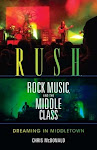
I am Chris McDonald, author of Rush, Rock Music, and the Middle Class: Dreaming in Middletown, which was published last fall by Indiana University Press.
This blog is intended as an informal sounding board for developing new ideas and new research into the relationship between music and social class, with a special emphasis on the middle class. I welcome input from those interested in topics related to popular music, the middle class, and (of course!) Rush.
I'm not intending for Rush to be the focus of this blog, but I expect to be blogging about them periodically.
New musical topics that I'm becoming tentatively interested in as "middle-class culture" include progressive rock, singer-songwriters, folk revivalism, and musical eclecticism.
This blog is intended as an informal sounding board for developing new ideas and new research into the relationship between music and social class, with a special emphasis on the middle class. I welcome input from those interested in topics related to popular music, the middle class, and (of course!) Rush.
I'm not intending for Rush to be the focus of this blog, but I expect to be blogging about them periodically.
New musical topics that I'm becoming tentatively interested in as "middle-class culture" include progressive rock, singer-songwriters, folk revivalism, and musical eclecticism.
Subscribe to:
Posts (Atom)