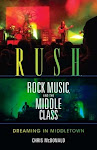
Well, I'm having a little author's regret about not talking more in depth in Dreaming in Middletown about Rush's "The Trees," an enduringly popular song from Hemispheres (1978).
I addressed it briefly while talking about the political meanings of individualism as Rush used it. But this song, which is told a bit like a kid's fairy tale or fable, bears a lot more discussion from the standpoint of class.
Above all, it's the one Rush song that specifically and literally is about stratification.
Neil Peart transposes this issue to the forest: the Oaks, by virtue of naturally growing the tallest, get most of the sunlight; the Maples, shorter in stature, get less. The Maples demand an equal share of the sunlight, but the Oaks balk. The Maples form a union, protest loudly, and a law is passed that light shall be distributed evenly. The result is that the forest is cut down to stumps.
What view of social stratification does this song provide?
The lyrics seem fairly straightforward on this: stratification is considered an inevitable, perhaps natural, aspect of society. Some have more access to wealth and resources than others. Attempts to alter the existing arrangement (e.g., by unions) are unwelcome in this story: more equitable distribution results in catastrophe.
Anyone who cares already knows that Peart was influenced by Ayn Rand at this time, and the influence of her philosophy on this song is so obvious as to make comment unnecessary. I’m not really interested in literary influence here, anyway: I’m much more interested in thinking about how social positioning makes this story desirable or relevant.
Clearly, it’s a song that flatters conservative sensibilities: it cautions against changing the status quo. Existing inequities are deemed natural. The perspective seems at least middle class: the idea of lower classes banding together and making demands is portrayed as catastrophic, and perhaps this view is fuelled by middle-class status anxiety. I certainly don’t see how working-class interests are at all served by the song’s rhetoric, whatever my critics might say.
"The Trees" may be one of Rush's most perplexing songs.
Not musically, of course -- it's quite nice. The classical guitar intro is atmospheric and attractive. The rock sections are quintessential Rush -- odd meters, open chords, intense vocals -- as is the bridge, with its gentle arpeggios, unusual percussion items, and mysterious synthesizer. In less than five minutes, it pretty near captures the best in Rush's classic 1970s style.
The lyrics have been a weird sticking point. Rush's biographers have been pretty coy about what the song is really about. The British rock press, says Rush author Brian Harrigan, pilloried the band for making a sweeping conservative statement with the song, but Harrigan demurred, saying that "it can be read as a union-bashing song but I think that only diminishes what Peart is saying -- peaceful co-existence and live and let live are all" (1982). But in a review of Exit...Stage Left a short while later, Harrigan admitted that he found "The Trees" "jarring" politically.
I’ve seen this in a number of reviews of Rush, where the pro-Rush writer either avoids discussion of this song’s message or diverts from the (plain) message as Harrigan did. Reviewers who dislike Rush will raise this song as an example of band’s bafflingly strident defence of class privilege (see reviews of Rush in the NME, or Paul Stump’s summary in The Music’s All That Matters).
On the one hand, it’s interesting that the song evokes such reactions, since it reads like an almost simple-minded cartoon. But it tells a story about the important matter of social stratification, and it hits a nerve.
The middle class is conflicted on this topic, and this is where middle-class political sympathies get complicated. Some of us (maybe parts of us) identify with the Oaks: we deserve what we have, we see ourselves among the upright in society, we think what we do is important, etc. Some of us identify with the Maples: stratification is not fair, merit is too often confused with chance or birthright, we are slipping from “haves” into “have-nots” as the elite grows taller, and so on.
But that still doesn’t quite get at it. As I discussed in Dreaming in Middletown, the position from which Rush writes is mostly petit-bourgeois, lower middle class. This is the small business class, the freelance professionals, the shop-keepers -- the people who are politically and economically in-between -- who end up equally resenting unionism and corporate elites. They are told that they are the engine of the “real economy,” and they believe that, in a more laissez-faire world, they would be the Oaks. Stratification would work fine for them, if not for all the rule-changing, lobbying, and politicking that goes on and gerrymanders the system.
That’s my take on why something like “The Trees” portrays stratification as it does. We really need a good social history on movements like libertarianism and objectivism: so much discussion of them is either political (aimed at persuading or dissuading) or is abstractly philosophical. But so much of the story lies in who these movements appeal to, what needs or desires they address, and what historically accounts for their peaks and ebbs of popularity. Their role in debates over social stratification is ultimately a huge part of their raison d’etre.
Wednesday, July 28, 2010

Sunday, July 11, 2010
Disciplinary Divides, Social Divides? (II)
The New (Ethno)Musicologies, a collection edited by Henry Stobart, was published recently, and has a number of contributions that speak to the issue I wrote about a few months back.
The idea of a specific discipline catering to particular social categories, and hence certain musical topics, could be extended to further issues. The book features contributors from a number of different disciplines, many discussing how ethnomusicology and musical ethnography looks to them.
Fabian Holt, writing from popular music studies, notes that his discipline is focused on an Anglo-American pop canon where almost no ethnography is done. Ethnomusicology, when it focuses on popular music, looks almost entirely outside that canon, and does approach its topic ethnographically. He notes that many "American musics" not well-covered in popular music studies -- that of Asian-Americans, or Latin-Americans -- are far more likely to be picked up by ethnomusicologists.
Popular music studies, says Holt, sees its musical field as defined almost entirely by a dialectic between African- and Euro-American culture, gives Latin American music just a little attention, and Aboriginal and Asian-American musics almost no attention at all. The disciplinary lines in these inclusions and exclusions are clear for Holt: "To this day, there are deep differences in the core conventions of what is studied and how in popular music studies, musicology, and ethnomusicology" (p. 42).
I was happy to see an acknowledgement of how social class plays into this. Holt notes:
I generally agree, though as my previous posts indicate, the sense of what is canonically acceptable middle-class or working-class music to a hip middle-class gaze bears much further interrogation.
Michelle Bigenho, an anthropologist who studied musical culture in Bolivia, writes about why she refuses the designation "ethnomusicologist." What I found interesting here is her refusal to assume that music is a unique or autonomous category in culture. In her experience, anthropology treats music as a part of larger cultural themes and practices, while in ethnomusicology, the centrality of music as a topic tends to edge out (or overdetermine) other considerations. She blames the departments and institutions that structure our disciplines: music departments expect ethnomusicologists to play music, teach ensembles, teach area studies and genres, so that's what gets studied. Anthropologists would never do this; music is not always so isolatable, and indeed, this would be seen by some as a counterproductive way to understand a culture.
I'm just starting on Nicholas Cook's essay on musicology vis a vis ethnomusicology, but it looks like more promising insights on this are to come.
The idea of a specific discipline catering to particular social categories, and hence certain musical topics, could be extended to further issues. The book features contributors from a number of different disciplines, many discussing how ethnomusicology and musical ethnography looks to them.
Fabian Holt, writing from popular music studies, notes that his discipline is focused on an Anglo-American pop canon where almost no ethnography is done. Ethnomusicology, when it focuses on popular music, looks almost entirely outside that canon, and does approach its topic ethnographically. He notes that many "American musics" not well-covered in popular music studies -- that of Asian-Americans, or Latin-Americans -- are far more likely to be picked up by ethnomusicologists.
Popular music studies, says Holt, sees its musical field as defined almost entirely by a dialectic between African- and Euro-American culture, gives Latin American music just a little attention, and Aboriginal and Asian-American musics almost no attention at all. The disciplinary lines in these inclusions and exclusions are clear for Holt: "To this day, there are deep differences in the core conventions of what is studied and how in popular music studies, musicology, and ethnomusicology" (p. 42).
I was happy to see an acknowledgement of how social class plays into this. Holt notes:
Academic culture has largely been centred on the white middle-class male subject, and middle-class values have defined the status of individual musics. Western, especially German, art music was the single privileged domain of early musicology, and it still dominates in...prestige. Conversely, stereotypes of "non-Western" musics and popular musics have worked to the disadvantage of scholars in ethnomusicology and popular music studies. Middle-class dominance in the latter is evident in almost complete ignorance of a working-class rural music such as country music.
I generally agree, though as my previous posts indicate, the sense of what is canonically acceptable middle-class or working-class music to a hip middle-class gaze bears much further interrogation.
Michelle Bigenho, an anthropologist who studied musical culture in Bolivia, writes about why she refuses the designation "ethnomusicologist." What I found interesting here is her refusal to assume that music is a unique or autonomous category in culture. In her experience, anthropology treats music as a part of larger cultural themes and practices, while in ethnomusicology, the centrality of music as a topic tends to edge out (or overdetermine) other considerations. She blames the departments and institutions that structure our disciplines: music departments expect ethnomusicologists to play music, teach ensembles, teach area studies and genres, so that's what gets studied. Anthropologists would never do this; music is not always so isolatable, and indeed, this would be seen by some as a counterproductive way to understand a culture.
I'm just starting on Nicholas Cook's essay on musicology vis a vis ethnomusicology, but it looks like more promising insights on this are to come.
Tuesday, June 15, 2010
Voice, Class, and the Inescapable Barthes
I swear to God, I'll rip out what's left of my hair if one more popular music scholar name-checks Roland Barthes and "The Grain of the Voice!"
Whew -- now I feel better.
Seriously, though, what is it about this (admittedly rich and piquant) little article from 1977 (reprinted in On Record) that leads everyone from grad students to senior music scholars to invoke it every time the singing voice is tabled for discussion? Is it really the most insightful thing written on the voice in more than 30 years?
I got to thinking about this recently while researching for my IASPM/CSTM Regina presentation, because it kept turning up in every other popular music studies article or book chapter I picked up. I've been noting this for some time, but when Barthes was cited three times in one day at the conference, I decided that I really needed to go back and re-read this article and think about it. I became really curious about why it seems so inexhaustibly relevant to so many, even thirty-some years after it first appeared.
What's particularly interesting is that no one seems to criticize Barthes's concept of the "grain" of the voice, at least in our discipline; it's always invoked, applied cursorily, and then left. It's probably beyond my limitations to criticize Barthes directly, but on re-reading the article, I'm left with a number of questions and reservations about its application in music scholarship.
Why, for example, is an article principally concerned with the voice in European classical music so influential on popular music studies?
The driving force behind Barthes's discussion of vocal "grain" is his preference for the opera singer Panzera over the more popular Fischer-Dieskau. Although Barthes insists his choice of singers (for illustrating vocals with grain vs. vocals without grain) is not important (they are just "ciphers," he says), it's hard not to read the article as a very sophisticated justification for personal preference. This seems more like "music criticism" than "cultural criticism," so what does it mean that his model is used principally for the latter in popular music scholarship?
Is "grain" the most accurate translation of what Barthes means?
Presumably, the term "grain of the voice" is meant to be roughly analogous with "grain in the wood" or "grain of the rock," a texture or internal pattern that is unique to a wooden plank or something. On its face, it's a striking analogy to think about, because an individual's voice is so unique and recognizable, and yet we lack a substantial language to describe it.
But Barthes has a more complicated notion in mind: vocal grain is "the body in the voice as it sings," it's the "materiality of the body speaking its mother tongue." It's more than timbre, he says. He clearly gets off on a voice that is relatively unruly, insofar as you hear the tongue itself, the wet snap of tissue in the mouth and throat, the click and scratch of teeth, and so on. Panzera made artful use of these qualities, for Barthes, while he heard nothing in Fischer-Dieskau except clean, clear vocal tone. Panzera is unbridled bodily sensuality, ambiguity, etc.; Fischer-Dieskau politely, clearly and cleanly serves the music. The former has grain, the latter doesn't.
It's hard for me not to hear where this is all going in a very "classed" sense: Panzera gives the upper-middle-class French intellectual lots of "bodily" stuff to dive into, to appreciate sensually (albeit in a very theoretical language) in a vaguely avant-garde way. Fischer-Dieskau, by being "clear," in Barthes's words, by singing in a way that makes sense with respect to the expressive context set up by the song, is being too utilitarian, obvious, etc. In other words, Fischer-Dieskau is almost middlebrow, acceptable to a lower-middle-class sensibility.
Maybe that's why I get a bit irked reading Barthes: he's a French upper-middle-class theorist-provocateur, while I'm a pragmatic North American Anglo petit-bourgeois, outfoxed again!
But this is the real question: what does the concept of "grain" (and its attendant concepts, scooped up from Kristeva, the pheno-song and geno-song) do for us?
I've seen people apply this very nearly by rote to pop singers, whereby notions of "grain" get applied to a certain kind of singer (Bob Dylan, Janis Joplin, Robert Plant, Tom Waits, etc.) while a lack of grain is more paradigmatic of a pop singer whose tone, style and training more closely aligns with crooning, Broadway style, or mainstream pop.
The problem for me is that "grain" is still being deployed with a sneaky undercurrent of value judgment, which doesn't generate new understanding, but buttresses the same old assumptions about why some singers are great, and others are run of the mill. It becomes another tool in maintaining the authentic/inauthentic dyad, or the artiste/entertainer dichotomy.
Really, just as no wood is without grain, I don't like the idea that some voices have no grain. Maybe some are smoother than others, maybe some have more texture than others -- that's fine. Maybe you can hear more "body" (in Barthes's sense) in one voice than another, but why is more body-in-the-voice always necessarily better?
Finally, how has the idea that Barthes came up with been elaborated for our purposes in musicology or popular music studies? Obviously, it still speaks to a lot of people, but are we getting anywhere with it? For something cited so frequently, it seems like very little has been added to build up the theory.
Maybe I'm missing something: I'm open to hearing from those who think Barthes's theory deserves the attention it receives, at least in our discipline.
Whew -- now I feel better.
Seriously, though, what is it about this (admittedly rich and piquant) little article from 1977 (reprinted in On Record) that leads everyone from grad students to senior music scholars to invoke it every time the singing voice is tabled for discussion? Is it really the most insightful thing written on the voice in more than 30 years?
I got to thinking about this recently while researching for my IASPM/CSTM Regina presentation, because it kept turning up in every other popular music studies article or book chapter I picked up. I've been noting this for some time, but when Barthes was cited three times in one day at the conference, I decided that I really needed to go back and re-read this article and think about it. I became really curious about why it seems so inexhaustibly relevant to so many, even thirty-some years after it first appeared.
What's particularly interesting is that no one seems to criticize Barthes's concept of the "grain" of the voice, at least in our discipline; it's always invoked, applied cursorily, and then left. It's probably beyond my limitations to criticize Barthes directly, but on re-reading the article, I'm left with a number of questions and reservations about its application in music scholarship.
Why, for example, is an article principally concerned with the voice in European classical music so influential on popular music studies?
The driving force behind Barthes's discussion of vocal "grain" is his preference for the opera singer Panzera over the more popular Fischer-Dieskau. Although Barthes insists his choice of singers (for illustrating vocals with grain vs. vocals without grain) is not important (they are just "ciphers," he says), it's hard not to read the article as a very sophisticated justification for personal preference. This seems more like "music criticism" than "cultural criticism," so what does it mean that his model is used principally for the latter in popular music scholarship?
Is "grain" the most accurate translation of what Barthes means?
Presumably, the term "grain of the voice" is meant to be roughly analogous with "grain in the wood" or "grain of the rock," a texture or internal pattern that is unique to a wooden plank or something. On its face, it's a striking analogy to think about, because an individual's voice is so unique and recognizable, and yet we lack a substantial language to describe it.
But Barthes has a more complicated notion in mind: vocal grain is "the body in the voice as it sings," it's the "materiality of the body speaking its mother tongue." It's more than timbre, he says. He clearly gets off on a voice that is relatively unruly, insofar as you hear the tongue itself, the wet snap of tissue in the mouth and throat, the click and scratch of teeth, and so on. Panzera made artful use of these qualities, for Barthes, while he heard nothing in Fischer-Dieskau except clean, clear vocal tone. Panzera is unbridled bodily sensuality, ambiguity, etc.; Fischer-Dieskau politely, clearly and cleanly serves the music. The former has grain, the latter doesn't.
It's hard for me not to hear where this is all going in a very "classed" sense: Panzera gives the upper-middle-class French intellectual lots of "bodily" stuff to dive into, to appreciate sensually (albeit in a very theoretical language) in a vaguely avant-garde way. Fischer-Dieskau, by being "clear," in Barthes's words, by singing in a way that makes sense with respect to the expressive context set up by the song, is being too utilitarian, obvious, etc. In other words, Fischer-Dieskau is almost middlebrow, acceptable to a lower-middle-class sensibility.
Maybe that's why I get a bit irked reading Barthes: he's a French upper-middle-class theorist-provocateur, while I'm a pragmatic North American Anglo petit-bourgeois, outfoxed again!
But this is the real question: what does the concept of "grain" (and its attendant concepts, scooped up from Kristeva, the pheno-song and geno-song) do for us?
I've seen people apply this very nearly by rote to pop singers, whereby notions of "grain" get applied to a certain kind of singer (Bob Dylan, Janis Joplin, Robert Plant, Tom Waits, etc.) while a lack of grain is more paradigmatic of a pop singer whose tone, style and training more closely aligns with crooning, Broadway style, or mainstream pop.
The problem for me is that "grain" is still being deployed with a sneaky undercurrent of value judgment, which doesn't generate new understanding, but buttresses the same old assumptions about why some singers are great, and others are run of the mill. It becomes another tool in maintaining the authentic/inauthentic dyad, or the artiste/entertainer dichotomy.
Really, just as no wood is without grain, I don't like the idea that some voices have no grain. Maybe some are smoother than others, maybe some have more texture than others -- that's fine. Maybe you can hear more "body" (in Barthes's sense) in one voice than another, but why is more body-in-the-voice always necessarily better?
Finally, how has the idea that Barthes came up with been elaborated for our purposes in musicology or popular music studies? Obviously, it still speaks to a lot of people, but are we getting anywhere with it? For something cited so frequently, it seems like very little has been added to build up the theory.
Maybe I'm missing something: I'm open to hearing from those who think Barthes's theory deserves the attention it receives, at least in our discipline.
Wednesday, June 9, 2010
A Class Without A Culture?
I've returned from the IASPM/CSTM conference in Regina, which was entitled Spaces of Violence, Sites of Resistance: Music, Media, and Performance. The quality of presentations was quite high, and I enjoyed lots of stimulating papers and discussions.
My presentation on the problems and potentials of studying the middle class and popular music was well-received, and lots of people have followed up with suggestions for other sources and papers.
One strand from the paper which bears further elaboration concerns the (white) middle class's cultural obsession with alterity and the other. I argued that the perception of the middle class as an invisible "norm," and also as something prosaic or lame, has led middle-class cultural consumers to be looking continuously outside themselves for something more real, authentic, vivid, etc., than what traditionally middle class popular culture has provided. This process accelerated during and after the big cultural and political changes of the 1960s, altering middle-class tastes, both in content and range, beyond recognition.
In a discussion with my colleague, Norm Stanfield of UBC, we talked about how the white, American middle-class culture which has been all but rejected by its inheritors (think here about orchestral pop, Tin Pan Alley crooning, etc.), has been enthusiastically picked up by other middle classes emerging around the world (China's emerging middle class and Chinese-American immigrants provide good examples). Crooners are popular, as are lush orchestral (or synthesized) textures, ballad-type songs and a relaxed, sophisticated atmosphere. Yet, in most white, middle-class circles, few such pop sounds could be more unhip. It's like a mirror on what white, middle-class music used to be like, and for some reason, it makes a lot of people like me recoil.
Why is this?
Norm recommended an article in The Atlantic, entitled "The End of White America," by Hua Hsu. It's largely about the coming demographic shift when, in the 2040s, white people cease to be the majority ethnicity in the US. What kind of multi-ethnic or multi-racial country will the US (or Canada) be by then?
More urgently, how will white people respond to this demographic shift, and given that ethnic identity is always changing and evolving, what will it mean to be white then?
In discussing this question, Hsu talks about the state of white culture, although I think he's talking more specifically about white middle class culture. It's not simply that it's so ubiquitous that it's invisible, or considered just "normal," but that it has pretty much been abandoned.
Much like I argued in my own paper, Hsu discusses how the baby-boomers (and later generations) ceased looking towards the genteel culture to which the middle class has traditionally been heir, and has instead embraced a fluid, eclectic cultural field focussed principally on people unlike themselves.
The consequence of this is double-edged: perhaps white middle-class North Americans have become more open-minded and tolerant of the culture of others, but at the expense of having any substantive culture of their own. They have become, more literally than before, cultureless.
Hsu quotes sociologist Matt Wray, who notes of his own white, middle-class students:
Hsu holds up William "Upski" Wimsatt's book Bomb the Suburbs (1994) as a symptomatic text documenting the move towards a white, middle-class culture that is focussed almost exclusively on alterity. Wimsatt valorizes the white middle-class hip hop fan for adopting black American culture as fully as possible, much as Norman Mailer did 50 years ago in The White Negro. The very implication of Wimsatt's book title -- destroy where we live, erase what we are -- is evocative of the kind of self-loathing that marks modern, hip attitudes towards middle-class identity.
In a future where there is no majority, Hsu surmises, a cultureless whiteness may be a problem indeed.
The reason I see Hsu's cultureless whiteness as being more of a middle-class issue than a working-class one is that I don't think the white working class has been nearly as quick to abandon its culture. They're far less embarrassed about their country music proclivities, for example, than we've been about our mainstream pop.
My presentation on the problems and potentials of studying the middle class and popular music was well-received, and lots of people have followed up with suggestions for other sources and papers.
One strand from the paper which bears further elaboration concerns the (white) middle class's cultural obsession with alterity and the other. I argued that the perception of the middle class as an invisible "norm," and also as something prosaic or lame, has led middle-class cultural consumers to be looking continuously outside themselves for something more real, authentic, vivid, etc., than what traditionally middle class popular culture has provided. This process accelerated during and after the big cultural and political changes of the 1960s, altering middle-class tastes, both in content and range, beyond recognition.
In a discussion with my colleague, Norm Stanfield of UBC, we talked about how the white, American middle-class culture which has been all but rejected by its inheritors (think here about orchestral pop, Tin Pan Alley crooning, etc.), has been enthusiastically picked up by other middle classes emerging around the world (China's emerging middle class and Chinese-American immigrants provide good examples). Crooners are popular, as are lush orchestral (or synthesized) textures, ballad-type songs and a relaxed, sophisticated atmosphere. Yet, in most white, middle-class circles, few such pop sounds could be more unhip. It's like a mirror on what white, middle-class music used to be like, and for some reason, it makes a lot of people like me recoil.
Why is this?
Norm recommended an article in The Atlantic, entitled "The End of White America," by Hua Hsu. It's largely about the coming demographic shift when, in the 2040s, white people cease to be the majority ethnicity in the US. What kind of multi-ethnic or multi-racial country will the US (or Canada) be by then?
More urgently, how will white people respond to this demographic shift, and given that ethnic identity is always changing and evolving, what will it mean to be white then?
In discussing this question, Hsu talks about the state of white culture, although I think he's talking more specifically about white middle class culture. It's not simply that it's so ubiquitous that it's invisible, or considered just "normal," but that it has pretty much been abandoned.
Much like I argued in my own paper, Hsu discusses how the baby-boomers (and later generations) ceased looking towards the genteel culture to which the middle class has traditionally been heir, and has instead embraced a fluid, eclectic cultural field focussed principally on people unlike themselves.
The consequence of this is double-edged: perhaps white middle-class North Americans have become more open-minded and tolerant of the culture of others, but at the expense of having any substantive culture of their own. They have become, more literally than before, cultureless.
Hsu quotes sociologist Matt Wray, who notes of his own white, middle-class students:
They don't care about socioeconomics; they care about culture. And to be white is to be culturally broke. The classic thing white students say when you ask them to talk about who they are is, "I don't have a culture." They might be privileged, they might be loaded socioeconomically, but they feel bankrupt when it comes to culture … They feel disadvantaged, and they feel marginalized. They don’t have a culture that's cool or oppositional.
Hsu holds up William "Upski" Wimsatt's book Bomb the Suburbs (1994) as a symptomatic text documenting the move towards a white, middle-class culture that is focussed almost exclusively on alterity. Wimsatt valorizes the white middle-class hip hop fan for adopting black American culture as fully as possible, much as Norman Mailer did 50 years ago in The White Negro. The very implication of Wimsatt's book title -- destroy where we live, erase what we are -- is evocative of the kind of self-loathing that marks modern, hip attitudes towards middle-class identity.
In a future where there is no majority, Hsu surmises, a cultureless whiteness may be a problem indeed.
The reason I see Hsu's cultureless whiteness as being more of a middle-class issue than a working-class one is that I don't think the white working class has been nearly as quick to abandon its culture. They're far less embarrassed about their country music proclivities, for example, than we've been about our mainstream pop.
Sunday, May 30, 2010
Presenting on Popular Music and the Middle Class
On Thursday, June 3, I'll be presenting a paper, "Popular Music and the Middle Class: Problems and Potentials in the Study of 'Dominant' Formations," at the joint IASPM-CSTM conference at the University of Regina.
It will discuss some of the stumbling blocks I found when studying both Rush and the singer-songwriter movement in relation to the North American middle class.
I'll be talking about the aversion to talking about class, and the seeming "invisibility" of the middle class, as two preliminary problems.
But I'm particularly interested in how the recieved wisdom and myths about the middle class weasel their way into the discussion, even if you try to avoid them. And I'm interested in how these myths seem to come from a place of embarassment or even self-hatred, since most studies of the middle class are actually studies of the self (that is, studies by middle-class writers about the class they come from).
Thus, we get the middle class as dull, as sick, as gentrifiers, and so on.
I'll post more about this, and how it relates to music, when I return.
It will discuss some of the stumbling blocks I found when studying both Rush and the singer-songwriter movement in relation to the North American middle class.
I'll be talking about the aversion to talking about class, and the seeming "invisibility" of the middle class, as two preliminary problems.
But I'm particularly interested in how the recieved wisdom and myths about the middle class weasel their way into the discussion, even if you try to avoid them. And I'm interested in how these myths seem to come from a place of embarassment or even self-hatred, since most studies of the middle class are actually studies of the self (that is, studies by middle-class writers about the class they come from).
Thus, we get the middle class as dull, as sick, as gentrifiers, and so on.
I'll post more about this, and how it relates to music, when I return.
Monday, April 5, 2010
The Middlebrow Bites Back
John Guillory wrote an incisive review of literary critic Harold Bloom's The Western Canon a while back.
Bloom's book, apart from being a summary of the great works of Western literature (Dante, Milton, Shakespeare, etc.), contained a caustic introductory essay and a biting conclusion, accusing the contemporary professoriate of destroying standards in the humanities and bitterly dismissing aesthetic value in the arts.
How does Bloom think they did this? By daring to look at the social and political contexts in which the great works of Western literature were created, and asking how canons themselves are formed.
Bloom's complaint partly rested on the notion that great literature's "greatness" was wholly dependent on aesthetic value, something that only dedicated and gifted ("deep") readers could access or experience. Any other question about it was either beside the point or actively subversive to the appreciation of great works.
Guillory brilliantly cut through Bloom's rhetoric, assertively showing who Bloom was aiming this book at, and why.
Bloom was not aiming at "deep readers" of Western literature, Guillory surmises. He was aiming at middlebrow readers who would never, ever actually read through any substantial portion of the canon. He told such an audience exactly what they wanted to hear: great literature is great, period. He gave them capsule summaries of great works so that they could feel, at some level, conversant with its topics, plots, and characters.
And he played right to their prejudices: great literature frustrates all attempts at analysis or interpretation. There are no politics here. Aesthetic greatness transcends history. In short, shut up and appreciate! And if you can't appreciate, just shut up!
Bloom -- despite being a professor himself -- plays to the anti-intellectual tendencies of a public that deeply mistrusts intellectual work. He accuses his colleagues of asking the wrong questions, teaching the wrong works of culture, undertaking studies that undermine, rather than buttress, the "old" way Western culture was taught.
Guillory argues that Bloom ended up creating an elitism that doubles as populism. Bloom seems to argue that the greatness of high culture needs to be protected from elite intellectuals, the very guardians and teachers of that culture. Anxiety about high culture -- what it is, who it is for, what it means -- is assuaged by assuring the middlebrow reader that it doesn't belong to anyone in particular.
Intellectual work on popular culture, interestingly enough, is sometimes met by the layperson with the kind of response Bloom encouraged: the charge is often that intellectuals over-analyze and miss the point of what they study.
One review of a recent popular music study (not mine) even states this outright, admonishing the author to just "shut up and play your guitar." But really, the reviewer was incensed that certain questions were asked, that critical reflection was undertaken, rather than discussing the music on its own (fan's?) terms.
Bloom's book, apart from being a summary of the great works of Western literature (Dante, Milton, Shakespeare, etc.), contained a caustic introductory essay and a biting conclusion, accusing the contemporary professoriate of destroying standards in the humanities and bitterly dismissing aesthetic value in the arts.
How does Bloom think they did this? By daring to look at the social and political contexts in which the great works of Western literature were created, and asking how canons themselves are formed.
Bloom's complaint partly rested on the notion that great literature's "greatness" was wholly dependent on aesthetic value, something that only dedicated and gifted ("deep") readers could access or experience. Any other question about it was either beside the point or actively subversive to the appreciation of great works.
Guillory brilliantly cut through Bloom's rhetoric, assertively showing who Bloom was aiming this book at, and why.
Bloom was not aiming at "deep readers" of Western literature, Guillory surmises. He was aiming at middlebrow readers who would never, ever actually read through any substantial portion of the canon. He told such an audience exactly what they wanted to hear: great literature is great, period. He gave them capsule summaries of great works so that they could feel, at some level, conversant with its topics, plots, and characters.
And he played right to their prejudices: great literature frustrates all attempts at analysis or interpretation. There are no politics here. Aesthetic greatness transcends history. In short, shut up and appreciate! And if you can't appreciate, just shut up!
Bloom -- despite being a professor himself -- plays to the anti-intellectual tendencies of a public that deeply mistrusts intellectual work. He accuses his colleagues of asking the wrong questions, teaching the wrong works of culture, undertaking studies that undermine, rather than buttress, the "old" way Western culture was taught.
Guillory argues that Bloom ended up creating an elitism that doubles as populism. Bloom seems to argue that the greatness of high culture needs to be protected from elite intellectuals, the very guardians and teachers of that culture. Anxiety about high culture -- what it is, who it is for, what it means -- is assuaged by assuring the middlebrow reader that it doesn't belong to anyone in particular.
Intellectual work on popular culture, interestingly enough, is sometimes met by the layperson with the kind of response Bloom encouraged: the charge is often that intellectuals over-analyze and miss the point of what they study.
One review of a recent popular music study (not mine) even states this outright, admonishing the author to just "shut up and play your guitar." But really, the reviewer was incensed that certain questions were asked, that critical reflection was undertaken, rather than discussing the music on its own (fan's?) terms.
Friday, March 19, 2010
Disciplinary Divides and Social Divides? (I)
Popular music studies is an interdisciplinary exercise.
Sociology, cultural studies, English, communications, musicology, music theory, ethnomusicology, anthropology -- these are some of the disciplines that have contributed to popular music studies.
But being interdisciplinary, as Stanley Fish once said, is so very hard to do.
At least part of the problem is that different disciplines come at any topic with their own strengths and weaknesses, and they tend to grab at topics which they can most easily explain. There are notable exceptions to this, but there seems to be a divide among the disciplines that do popular music studies, leading to very interesting musical divides. These, in turn, reflect social divides.
Take, for example, music theory's (and to a lesser degree, musicology's) contributions: the tendency has been to study popular song that has relatively complex forms and interesting chord progressions. Thus, progressive rock, psychedelic rock, the Beatles, and some of the more clever singer-songwriters have received significant attention. Heavy metal, too, has gotten its share of attention, with its modalities and virtuosic guitar solos providing fodder for analysis. Even recent work on girl groups draws off of a repertoire with some advanced compositional and arrangement techniques -- the world of the Brill Building and Motown was self-consciously professionalized, after all.
On the other side, consider cultural studies and sociology: their emphasis on working-class lifestyles and subcultures have led to revealing work on punk rock, the mods, the London rasta and rudie scene, and so on. Likewise, the interest in reading (postmodern) texts led to a flurry of studies on music video.
I'm obviously being reductive here to make a point, but I find it interesting how these two disciplinary areas have had little to say about musical topics across their divides. For example, in Frith and Horne's sociological book, Art into Pop, the authors stress in the introduction that this is about the role an education in fine arts had on musician-artists who ended up in popular music; they issue a stern caveat that they are not interested in so-called "art rock," that classically-influenced stuff that bands like ELP peddled. What follows is stuff like the Velvet Underground, Roxy Music, Talking Heads, PiL -- pop on the proto-punk/punk rock/new-wave axis.
On the other side of the divide, punk has gotten little musicological attention. In his seminal Rock: The Primary Text, musicologist Allan Moore dutifully (if briefly) surveys punk as a substyle of rock, only to dismiss it as something that will be seen as having had a limited stylistic influence on rock at large. (A speculation which I'm guessing was probably written around 1990, before alternative rock really took off -- the original book came out in 1993.)
I have to confess my own complicity in this divide: by writing about Rush, I was doing the musicological thing of diving into something that was self-consciously designed to be interesting to a certain kind of musician. Rush analyzes "well" musicologically. It's a convenient topic, from one standpoint.
What bears further thought is how the relationship between social divides and musical divides (which we are mostly aware of) also interrelates with disciplinary divides. Most of us working in popular music studies are striving to do interdisciplinary work, but each discipline carries its baggage.
Sociology, cultural studies, English, communications, musicology, music theory, ethnomusicology, anthropology -- these are some of the disciplines that have contributed to popular music studies.
But being interdisciplinary, as Stanley Fish once said, is so very hard to do.
At least part of the problem is that different disciplines come at any topic with their own strengths and weaknesses, and they tend to grab at topics which they can most easily explain. There are notable exceptions to this, but there seems to be a divide among the disciplines that do popular music studies, leading to very interesting musical divides. These, in turn, reflect social divides.
Take, for example, music theory's (and to a lesser degree, musicology's) contributions: the tendency has been to study popular song that has relatively complex forms and interesting chord progressions. Thus, progressive rock, psychedelic rock, the Beatles, and some of the more clever singer-songwriters have received significant attention. Heavy metal, too, has gotten its share of attention, with its modalities and virtuosic guitar solos providing fodder for analysis. Even recent work on girl groups draws off of a repertoire with some advanced compositional and arrangement techniques -- the world of the Brill Building and Motown was self-consciously professionalized, after all.
On the other side, consider cultural studies and sociology: their emphasis on working-class lifestyles and subcultures have led to revealing work on punk rock, the mods, the London rasta and rudie scene, and so on. Likewise, the interest in reading (postmodern) texts led to a flurry of studies on music video.
I'm obviously being reductive here to make a point, but I find it interesting how these two disciplinary areas have had little to say about musical topics across their divides. For example, in Frith and Horne's sociological book, Art into Pop, the authors stress in the introduction that this is about the role an education in fine arts had on musician-artists who ended up in popular music; they issue a stern caveat that they are not interested in so-called "art rock," that classically-influenced stuff that bands like ELP peddled. What follows is stuff like the Velvet Underground, Roxy Music, Talking Heads, PiL -- pop on the proto-punk/punk rock/new-wave axis.
On the other side of the divide, punk has gotten little musicological attention. In his seminal Rock: The Primary Text, musicologist Allan Moore dutifully (if briefly) surveys punk as a substyle of rock, only to dismiss it as something that will be seen as having had a limited stylistic influence on rock at large. (A speculation which I'm guessing was probably written around 1990, before alternative rock really took off -- the original book came out in 1993.)
I have to confess my own complicity in this divide: by writing about Rush, I was doing the musicological thing of diving into something that was self-consciously designed to be interesting to a certain kind of musician. Rush analyzes "well" musicologically. It's a convenient topic, from one standpoint.
What bears further thought is how the relationship between social divides and musical divides (which we are mostly aware of) also interrelates with disciplinary divides. Most of us working in popular music studies are striving to do interdisciplinary work, but each discipline carries its baggage.
Subscribe to:
Posts (Atom)